
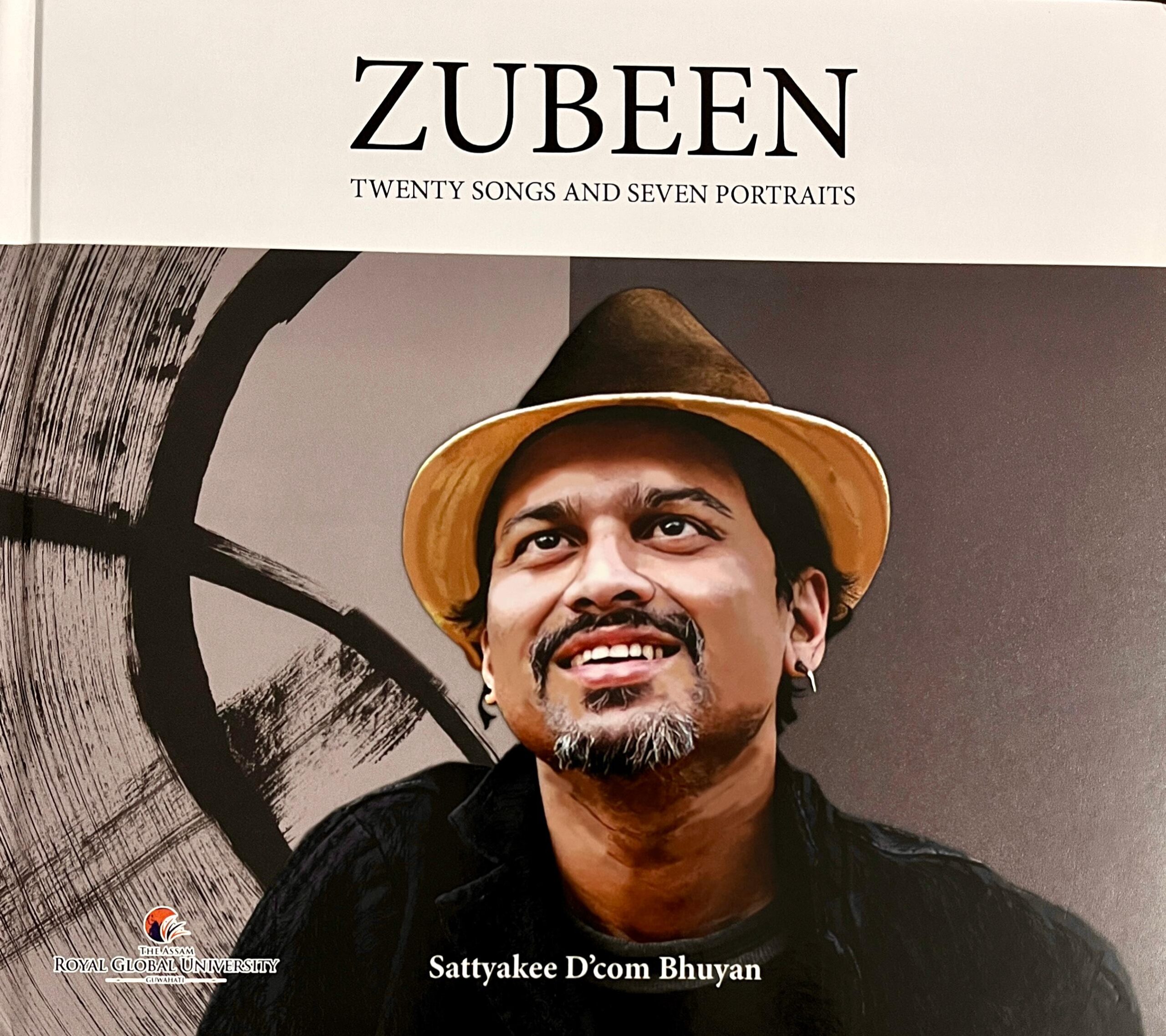
The idea of this book review began with a phone call from Mumbai. A friend wanted to read about Zubeen Garg—his life, his songs, and, more importantly, the meanings behind his lyrics. She was looking for something in English or Hindi, something that could help her understand why Zubeen matters so deeply to so many people. The search that followed only reminded me how scarce such books are. So when I finally held the book ZUBEEN in my hands, I realised that this was exactly what I had been looking for.
I received the book through the kindness of Dr Amar Jyoti Chaudhury, Chair Professor at the Dr Bhupen Hazarika Centre for Creativity, Royal Global University, and from the very first glance it was clear that this was not a routine publication. Beautifully produced and thoughtfully designed, ZUBEEN is edited by Sattyaki D’Com Bhuyan—though the cover design subtly suggests that he might be the sole author. In reality, the book is a carefully assembled collective portrait.
The volume brings together twenty songs by Zubeen Garg, translated into English by Arkupal Ra Acharya. These translations attempt the difficult task of carrying emotion, rhythm, and cultural nuance across languages—and in many places, they succeed in doing just that. The book also features a powerful selection of photographs curated by Stephen Styris, one of Assam’s leading photographers. These images do more than document a musician; they capture moods, moments, and silences. A particularly thoughtful addition is the musical notation of Zubeen’s iconic song Mayabini, prepared by Nise Meruno, reminding readers that this music is also meant to be played, not just remembered.
At the heart of the book are seven essays, referred to as “Portraits”—a title that reflects the editor’s imaginative approach. These are not conventional biographical essays; instead, they capture Zubeen Garg from different emotional, intellectual, and cultural angles. Amar Jyoti Chaudhury writes with warmth about his personal interactions with Zubeen, gently revealing the man behind the public image. Dr Palme Barthakur, Zubeen’s sister, offers a deeply personal account of his musical journey and temperament, striking a fine balance between affection and observation.
The essays by Mitra Phukan and Dr Rakhee Kalita Maral attempt to unpack what is often referred to as the “Zubeen phenomenon”—why he evokes such intense devotion, debate, and emotional identification. While their approaches differ, both reflect an effort to understand Zubeen not merely as a singer, but as a cultural force. The remaining contributions by Banasmita Das, Rahul Karmakar, and Ramanuj Dutta Chaudhury add further layers, engaging with Zubeen’s place in society, art, and popular consciousness.
What stands out throughout the book is the editor’s sincere effort to build a literary portrait rather than a celebratory catalogue. Sattyaki D’Com Bhuyan deserves credit for bringing together diverse voices and allowing them space to speak without forcing uniformity. Equally deserving of praise is Mukul M Baishya, whose cover design sets the right tone—tasteful, understated, and in quiet conversation with the subject of the book.
This is, without doubt, the book I was searching for—not only for my friend in Mumbai, but for any reader curious about Zubeen Garg beyond headlines and hit songs. That said, the book could have been even stronger with the inclusion of a brief chronological biography, especially for readers encountering Zubeen for the first time.
Even with that small absence, ZUBEEN remains a significant and sensitive book—one that listens to its subject as much as it speaks about him. It is less a definitive account and more a thoughtful conversation, and perhaps that is the most appropriate way to approach an artist like Zubeen Garg.

Utpal Datta, a distinguished figure in film criticism, authorship, and filmmaking, has garnered acclaim for his multifaceted contributions. Assam Govt honoured him with Literary Pension for his outstanding contribution to Assamese Literature. Honoured with two National Awards (Swarnakamal and Spl Jury Mention) for his film writing, his short films have graced the screens of significant film festivals, including the prestigious Indian Panorama at IFFI. His book on film appreciation has earned recognition, securing esteemed positions within the university syllabi of various academic institutions. Presently, he is a Professor of Practice at Assam downtown University. Email: utpal91@gmail.com / 7002153964